
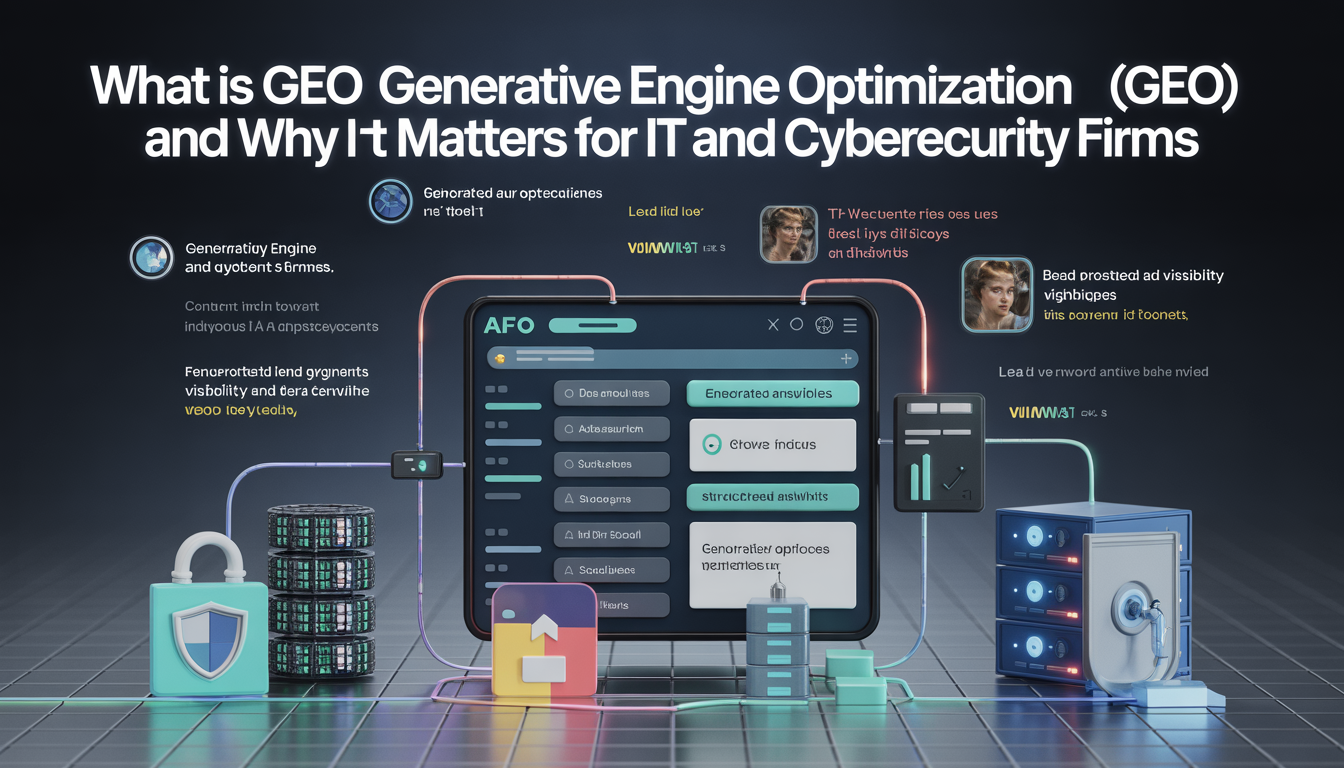
Generative Engine Optimization (GEO) is the practice of structuring, writing, and distributing content so that AI systems like ChatGPT, Perplexity, Claude, and Google AI Overviews recommend, mention, or cite your firm when generating answers.
For IT services and cybersecurity providers, GEO is rapidly becoming more valuable than traditional SEO because buyers now ask AI tools for vendor recommendations and shortlists rather than scrolling through search results.
Cybersecurity firms that master GEO build stronger visibility, better positioning, and ultimately improved sales performance.

Why GEO Has Suddenly Become Critical for IT and Security Firms
Cybersecurity buyers have changed how they research vendors. Instead of typing “top MSSPs in Texas” into Google and evaluating ten results, they now ask Claude or ChatGPT a richly contextual question and expect a synthesized recommendation.
This shift is happening fastest in B2B technology categories where:
- The buyer is technically literate and comfortable with AI tools.
- The decision is high stakes and warrants extensive research.
- The category is full of similar sounding vendors with overlapping claims.
- Independent verification matters more than vendor messaging.
Cybersecurity meets every one of these conditions. So does broader IT services. As a result, the firms that get named in AI generated answers are quietly winning the early stages of the buying journey while their competitors still focus on keyword rankings.
As a result, firms that appear in AI answers are quietly building stronger pipeline and more consistent lead generation system.
GEO is the discipline that earns those mentions.

Defining GEO Clearly
GEO is the optimization of content, brand presence, and authority signals so that generative AI systems include your firm in the answers they produce.
And that recommendation is driven by structure, authority, and clarity—supported by a strong digital marketing strategy.
A generative engine is any AI system that synthesizes a single, conversational response rather than returning a list of links. The major systems include:
- ChatGPT and ChatGPT Search
- Claude and the Claude app
- Perplexity AI
- Google AI Overviews and Gemini
- Microsoft Copilot
- Meta AI
These systems do not just retrieve documents. They read, evaluate, compress, and rewrite information from many sources into a unified reply. GEO is about making sure your firm survives that compression intact and with positive attribution.
How AI Selects Which Cybersecurity Firms to Mention
Generative engines use proprietary retrieval and ranking systems, but the selection patterns are observable and consistent.
Firms that consistently meet these criteria build long-term visibility and sustainable marketing growth strategy.
AI systems tend to mention cybersecurity providers when several conditions converge:
- Topical authority: The firm is consistently associated with the relevant cybersecurity domain (such as MDR, vCISO services, cloud security, or compliance consulting) across many sources.
- Entity clarity: The firm’s name, founders, certifications, and service categories are explicitly and consistently stated across owned and earned media.
- Third party reinforcement: The firm is mentioned in industry publications, analyst reports, podcast transcripts, review platforms (G2, Gartner Peer Insights, Clutch), and reputable databases.
- Original contributions: The firm has published research, threat reports, frameworks, or benchmark data that other sources cite.
- Structured content: The firm’s website uses clean headings, FAQ blocks, schema markup, and direct answer formatting that machines can extract easily.
- Recency: Content is updated, dated, and reflects current threat landscape and regulatory conditions.
- Specificity: The firm’s content addresses precise scenarios (industry, company size, regulatory environment) rather than generic claims.
A firm that satisfies most of these conditions develops what could be called a “semantic footprint” within AI systems. That footprint is what determines which names get surfaced when a CIO asks an AI assistant for recommendations.
Ranking Versus Being Recommended
The hardest mental shift for IT and cybersecurity marketers is moving from a ranking mindset to a recommendation mindset.
Ranking is positional and continuous. A page is #1, #5, or #50, and the goal is to climb. Being recommended by AI is binary and contextual. Either your firm is named in the answer for a given query, or it is not. There is no #2.
That’s why GEO must work alongside a structured AI SEO strategy.
Important differences:
- Ranking rewards comprehensive long form content targeting broad terms.
- Recommendation rewards clear, specific authority on well defined problems.
- Ranking is largely a page level competition.
- Recommendation is often a brand level and entity level competition.
- Ranking can be earned by SEO tactics alone.
- Recommendation depends on a wider footprint that includes earned media, original research, and third party validation.
A cybersecurity firm can rank #1 for “penetration testing services” and still never be mentioned when a security director asks ChatGPT “who should we hire for a SOC 2 readiness pen test on a Series B SaaS company.” The ranking page is too generic. The recommendation goes to the firm whose footprint matches the specific scenario.
Why “Being Recommended by AI” Is the New Visibility
Brand visibility in B2B has always been about being top of mind at the moment a buyer is ready to evaluate. AI assistants are now mediating that moment of evaluation at scale.
When a buyer hears your firm named in an AI generated answer, several things happen:
- Your firm enters the consideration set without the buyer ever visiting your website.
- The mention carries implicit endorsement, since the AI is perceived as a neutral synthesizer.
- The buyer is more likely to perform a branded search for your firm later.
- Your firm becomes anchored to the specific problem the buyer was researching.
This is mind share acquisition without click through. Traditional analytics will not show it directly, but its effects appear in branded search lift, demo requests that name the firm specifically, and shorter sales cycles because the trust building has already started.

Real World GEO Scenarios for Cybersecurity Firms
Consider how GEO plays out in three common scenarios.
Scenario 1: Mid market healthcare CIO researching HIPAA aligned MSSPs The CIO asks Claude to compare options for outsourced security operations with healthcare specific compliance experience. Claude synthesizes from analyst notes, healthcare IT publications, vendor case studies, and review platforms. The firms named are those with consistent healthcare cybersecurity content, named compliance experts, third party recognition in healthcare IT media, and specific HIPAA related schema and content on their site.
Scenario 2: Series B SaaS founder needing a vCISO The founder asks ChatGPT for vCISO providers experienced with SaaS security and SOC 2 readiness. ChatGPT cites firms whose websites clearly position vCISO services for SaaS, whose founders have public expertise (LinkedIn, podcast appearances, conference talks), and whose content explicitly addresses SOC 2 readiness with structured, quotable guidance.
Scenario 3: Manufacturing CFO evaluating ransomware response retainers The CFO asks Perplexity what to look for in an incident response retainer for a manufacturing firm. Perplexity surfaces firms cited in industry publications about manufacturing cybersecurity, those with original ransomware research, and those whose content includes specific, structured answers about retainer scope, response times, and pricing models.
In every scenario, the firms named are not necessarily the largest or the highest ranking on Google. They are the firms with the strongest GEO footprint for the specific problem.
What GEO Requires That Traditional SEO Did Not
Many SEO fundamentals still apply. Crawlability, internal linking, page speed, and backlinks remain useful. But GEO adds requirements that most cybersecurity websites do not yet meet.
It also requires strong review and reputation signals that support local business growth signals.
GEO demands:
- Answer first writing that places direct, quotable answers in the first one to two sentences of every section.
- Entity rich content that ties your firm to specific cybersecurity domains, frameworks, and named experts.
- Schema and structured data including FAQPage, Organization, Person, and Service schema.
- Distributed authority across podcasts, industry publications, analyst databases, review platforms, and Wikipedia where appropriate.
- Original research and proprietary data that becomes citable by other sources.
- Consistency of messaging and facts across every property where the firm appears.
- Named experts with public credentials, bios, and visible thought leadership.
How to Begin Building a GEO Footprint
The transition from SEO to GEO does not require abandoning existing investments. It requires layering new disciplines on top.
These steps strengthen visibility and help increase business performance.
Practical first moves for cybersecurity firms:
- Audit your top performing service pages and rewrite each section to lead with direct, quotable answers.
- Add comprehensive FAQ blocks to every service and solution page, marked up with FAQPage schema.
- Build dedicated entity pages for your methodology, certifications, frameworks, and named experts.
- Publish at least one original piece of research per quarter (threat report, industry survey, benchmark study).
- Pursue podcast appearances, expert quote requests, and bylined articles in cybersecurity publications.
- Claim and complete profiles on G2, Clutch, Gartner Peer Insights, and other relevant platforms.
- Track AI visibility manually and through emerging tools, monitoring how your brand appears across major generative engines.
The Compounding Advantage of Early GEO Investment
GEO results compound in ways that SEO never quite did. Each authority signal reinforces the next. Each AI mention drives branded search lift. Each branded search produces more direct engagement, which produces more case studies and content, which produces more citations.
Conversely, the cost of waiting compounds. Once an AI system establishes a preferred set of sources for a topic, dislodging those sources requires significantly more investment than earning the position originally would have.
For cybersecurity firms, the GEO window is unusually open right now because most competitors have not yet started. The firms that move in the next 12 to 24 months will lock in defensible visibility advantages.
Over time, this creates sustainable marketing growth strategy and consistent demand.

FAQ
What does GEO stand for in marketing? GEO stands for Generative Engine Optimization. It is the practice of optimizing content so AI systems include your brand in their generated answers.
How is GEO different from SEO? SEO targets ranking in a list of links. GEO targets being mentioned, recommended, or cited within an AI generated answer.
Is GEO replacing SEO for cybersecurity firms? GEO is not replacing SEO; it is extending it. SEO fundamentals still matter, but GEO is now essential for visibility in AI mediated buyer journeys.
Which AI engines should cybersecurity firms prioritize for GEO? Focus on ChatGPT, Perplexity, Claude, and Google AI Overviews first. Optimization work that performs well on one tends to perform across all of them.
How does AI decide which cybersecurity firms to recommend? AI considers topical authority, entity clarity, third party reinforcement, original research, structured content, recency, and specificity to the buyer’s scenario.
Do backlinks still matter for GEO? Yes. Backlinks remain a strong authority signal that influences which sources LLMs treat as trustworthy.
Can a small MSP compete with large MSSPs in GEO? Yes. Smaller firms often outperform large competitors in niche industries, geographies, or service specializations by producing precise, expert content.
How long does it take to see GEO results? Typically three to nine months, with compounding gains over 12 to 24 months as authority signals accumulate.
What metrics should cybersecurity firms track for GEO? Track AI mentions, share of voice in AI answers, branded search lift, and demo requests that reference AI exposure during discovery calls.
Does original research really matter for GEO? Yes. Original research is one of the most cited content formats by AI systems and creates compounding authority over time.
Should cybersecurity firms publish on Wikipedia? Only when genuinely warranted by notability standards. A well maintained, accurate Wikipedia presence influences how LLMs treat your firm as an entity.
What is the single most important first step in GEO? Rewrite the top of every important page to lead with a direct, quotable answer that an AI could extract and cite without further context.
Can AI generated content be used for GEO? You can use AI as a drafting tool, but human editing, original insight, named experts, and verifiable claims are essential to earn AI citations.
Does GEO work for IT services beyond cybersecurity? Yes. The same principles apply to managed IT services, cloud consulting, ERP implementation, and any B2B technology category where buyers research extensively.
Written by Razvan Calarasu: Founder of High 5 Guru, specializing in AI visibility, GEO, and AEO strategies for Digital Marketing firms.
Key Takeaways
- GEO is the optimization of content and authority signals so AI systems recommend your cybersecurity firm.
- Being mentioned by AI is the new form of visibility, replacing positional ranking for many high value queries.
- AI selects firms based on topical authority, entity clarity, third party recognition, and structured content.
- GEO compounds over time, and early movers gain defensible advantages.
- Cybersecurity firms that delay GEO will find AI has settled on competitor recommendations that are difficult to displace.